
Latvia’s shadow economy remains high – Is it time for new initiatives?
According to the latest findings from the SSE Riga Shadow Economy Index for the Baltic Countries presented on June 15, 2026, the size of Latvia’s shadow economy increased slightly in 2025, reaching 21.8% of GDP. This represents a rise of 0.4 percentage points compared to 2024.
A similar increase was observed in Estonia, where the shadow economy grew by 1.4 percentage points to 20.8% of GDP. In contrast, Lithuania recorded a decline, with the shadow economy falling to 23.6% of GDP, down 1.1 percentage points from the previous year.
The Shadow Economy Index has been calculated annually across the Baltic countries since 2009. According to the study’s authors, SSE Riga professors Dr. Tālis Putniņš and Dr. Arnis Sauka, the data indicate a continuing convergence in shadow economy levels across the three countries, following the trend already observed last year.
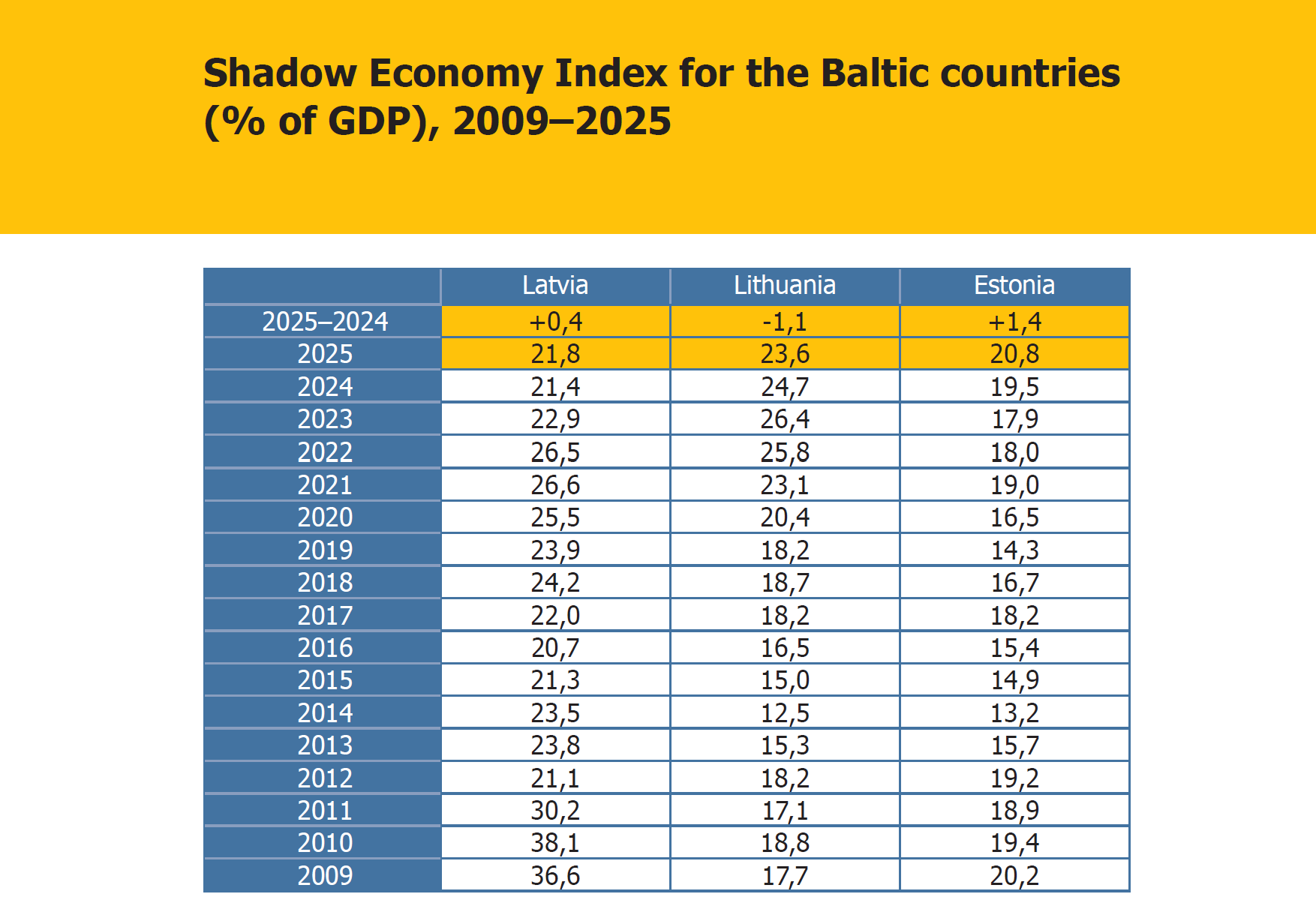
“Lithuania continues to have the largest shadow economy among the Baltic countries, although its size is decreasing. Estonia remains the country with the lowest shadow economy, despite the recent increase. Notably, Estonia recorded its highest shadow economy level since measurements began in 2009,” the authors note.
The researchers emphasize that the latest results do not reveal statistically significant changes in the size of the shadow economy in any of the Baltic countries. One possible explanation is that anti-shadow economy measures introduced in previous years may have already delivered most of their potential impact.
“The data suggest that, without maintaining existing policy measures and introducing new initiatives, there is little reason to expect further improvements,” the authors conclude.
Envelope Wages Remain the Largest Component
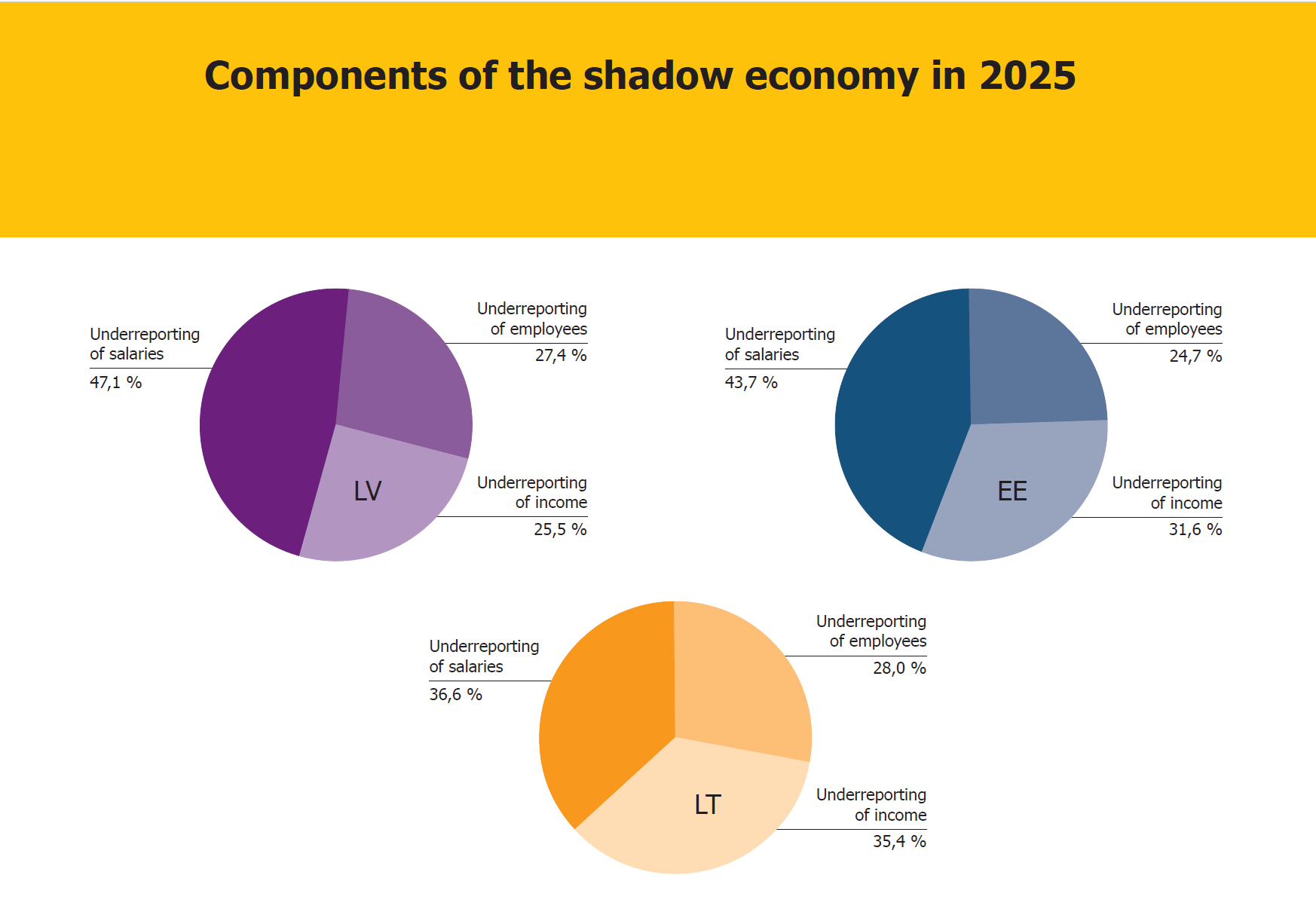
The study finds that envelope wages remained the largest component of the shadow economy in all three Baltic Countries in 2025. In Latvia, envelope wages accounted for 47.1% of total shadow economy activity, compared with 43.7% in Estonia and 36.6% in Lithuania.
In Latvia, unreported business income represented 25.5% of the shadow economy, while unregistered employees accounted for 27.4%. In Estonia, the respective shares were 31.6% and 24.7%, while in Lithuania they stood at 35.4% and 28.0%.
Compared with 2024, the average share of wages paid as undeclared “envelope wages” continued to decline in Latvia and Lithuania. In Latvia, it fell by 1.1 percentage points to 19.6%, while in Lithuania it declined by 0.3 percentage points to 17.8%. Estonia, however, recorded an increase of 0.7 percentage points, reaching 17.9%.
Regional and Sectoral Differences in Latvia
The highest level of shadow economy activity in Latvia was recorded in Latgale (25.7%), followed by Vidzeme (22.2%), Kurzeme (22.1%), the Riga region (21.3%), and Zemgale (19.0%).
By industry, construction continues to record the highest shadow economy share at 29.5%, despite a decline of 4.3 percentage points compared with 2024. Retail trade reached 24.5%, services 22.3%, manufacturing 19.2%, and wholesale trade 15.6%.
Satisfaction with Tax Administration Reaches Record High in Latvia
Businesses across the Baltic countries remain relatively satisfied with their tax administrations. In Latvia, satisfaction with the State Revenue Service (Valst ieņēmumu dienests) increased to 3.67 points on a five-point scale, the highest level recorded since measurements began in 2010.
Entrepreneurs in Latvia and Estonia also reported higher satisfaction with national tax policy in 2025, while Lithuania experienced a decline. At the same time, satisfaction with government support for businesses increased in all three Baltic countries.
Reducing the Shadow Economy Must Remain a Priority
Commenting on the findings, SSE Riga Professor Dr. Arnis Sauka stressed the importance of maintaining momentum in efforts to reduce the shadow economy.
“The funds currently lost to the shadow economy would be extremely valuable for financing national defence and other public priorities. Reducing the shadow economy is undoubtedly more difficult than borrowing, increasing the budget deficit, or raising taxes. However, in the long run, it is also far more effective.”
The SSE Riga Shadow Economy Index has been calculated annually across the Baltic countries since 2009 and remains one of the region’s most comprehensive measures of unreported economic activity.
This research is funded by the Latvian Council of Science, project Unequal Shadows: Informality, Kinship and Tax Morale in Latvia, project number lzp-2025/1-0346.
The Shadow Economy Index 2009-2025 in Latvian and English can be downloaded below.